
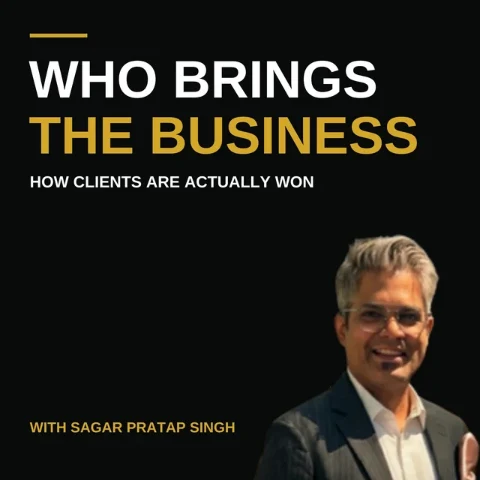
Founder Series · EP 01
Year One of a Law Firm: Abhishek Chaudhry, ABC Lawyers LLP
4 Nov 2026 · 27 min 43 sec
Listen to the full episode
About this episode
A year ago, Abhishek Chaudhry and his sister Bahaar left steady careers, one at a class actions boutique and one as a federal Crown prosecutor, to open ABC Lawyers LLP in Brampton, Ontario. They started with no inherited client list, no marketing department and no professional network in the city.
In the first episode of the WhoBringsTheBusiness Founder Series, Sagar Pratap Singh asks Abhishek what year one actually looked like: how the first paying client found them, where the rest of the year’s work came from, who in a two-partner firm owns new business, and the mistake that cost the most.
Abhishek is licensed in Ontario and New York and is a graduate of the Canada-US dual JD program at Windsor and Detroit Mercy. His practice covers immigration, corporate, and wills and estates, while Bahaar leads the firm’s criminal defence practice.
Key takeaways
- The first client came through trust, not visibility. A referral from a trusted source mattered more than how new the firm was.
- Referrals carried year one. Other lawyers and accountants passed on work they were not set up to handle, which is how most new practices get started.
- Social video opened a second referral channel. Short-form content on TikTok and Instagram, especially on criminal law, brought accountants and other professionals to the firm, and their referrals followed.
- In a two-partner firm, each practice finds clients differently. Criminal defence grows through legal aid and client word of mouth, while business and estates work comes mostly through professional referrals.
- Pricing was the most expensive lesson. Associates never have to price their own time, so a new founder has to learn what the work is worth to the client, not just how many hours it takes.
Chapters
- 0:00 Who brings the business when you are the business?
- 0:35 Meet Abhishek Chaudhry
- 1:55 Two law degrees at once
- 4:25 Leaving a safe job to start a firm
- 7:10 The bet on themselves
- 8:30 The first paying client
- 10:05 Where year-one clients came from
- 13:00 Who brings the business in a two-partner firm?
- 14:00 The most expensive mistake: pricing
- 15:30 Halfway recap
- 16:05 Language and newcomer clients
- 17:40 Canada’s great business handover
- 20:25 LinkedIn vs Instagram
- 22:15 Building a firm that lasts
- 23:05 Rapid fire
- 25:20 Day-one advice for new founders
- 27:15 Where to listen next
The interview
Lightly edited for length and clarity.
Sagar: Most people find one law degree hard enough. You did two at once, Canadian and New York. How did that happen?
Abhishek: I never set out with the idea of doing two law degrees. When I applied in 2018 and 2019, my sister and I both got into the University of Miami with a full scholarship for the first year. I was very tempted. But we also got into the dual JD program at Windsor, and Detroit Mercy was ABA approved, so we would still have options in the United States while keeping the Canadian degree. Windsor is about three and a half hours from the Greater Toronto Area. Then COVID hit in 2020 and the next two years of law school went online, so in hindsight it worked out better.
Sagar: You practised at a well-known boutique firm. What made you walk away and start your own firm?
Abhishek: My sister started with the provincial Crown, then joined a firm with a federal prosecution contract. I was at a boutique known for class actions, suing some of the biggest grocery retailers in Canada, and Amazon. But we always had the entrepreneurial bug. In law school we joked about who would be managing partner. Last spring I wanted to move back to Toronto, my sister said she would come too, we spent the summer figuring things out, and in the fall we launched ABC.
It is risky. With a job you have a paycheque every two weeks and colleagues down the hall. On your own you wear multiple hats. For the past two days I have been dealing with IT issues for our practice.
Sagar: On your first anniversary you wrote that you and your sister made a bet on yourselves. What exactly were you betting?
Abhishek: That we could make it work with no safety net. We had spent the last few years in Windsor, almost four hours away, so we came to Toronto with personal connections but no professional network and no stable income. A year in, you are still facing the same challenge, and on top of practising law you are doing marketing, IT and everything else.
Sagar: Take me back to your very first paying client. How did they find you, and why did they trust a firm only weeks old?
Abhishek: It was exciting, because before that every client had been my firm’s client. Then reality hits: their problem is now your problem. The client had been referred to me by someone I knew, and that helped a lot, because it came from a trusted source. The matter was not straightforward and it was a lot of work. The daunting part was doing it without a clerk or an assistant. A year on, it worked out fine.
Sagar: Looking at your clients from year one, where did they come from, and which source surprised you?
Abhishek: My sister’s practice started differently. A senior lawyer had more clients than he could handle and she helped take on that load, and legal aid is a big part of criminal defence in Ontario. For my business and estate law practice, referrals have been the biggest source. Every lawyer has work they are not comfortable doing, and they pass it along.
The surprise was social media. A lot of lawyers are hesitant to put themselves out there, but I always thought you should have multiple streams that complement each other. When I started making content about criminal law for my sister’s practice, our views on TikTok and Instagram skyrocketed. Other lawyers and professionals, especially accountants, started reaching out, and referrals came from those connections. Some of my best client relationships have come that way. I did a master’s in economics and enjoyed teaching, so I see my content as educating the public. If business comes from it, that’s a win-win.
Sagar: In a two-partner firm, who actually brings the business?
Abhishek: Our practices are completely different. Most of my sister’s clients come through legal aid, and then word of mouth brings private paying clients. My practice is primarily referral-based, through relationships with other lawyers and accountants. So we work almost independently of each other on that.
Sagar: What was the most expensive mistake you made in year one, and what did you change because of it?
Abhishek: Not knowing how to price the service from the start. Legal services take time, and a client is paying for my focus on their issue. I didn’t value my time the way I do now. At a firm you have billing targets, but you are not faced with the business of law, and law school doesn’t teach it. My biggest regret is that I didn’t learn it sooner. We are figuring it out as we go.
Sagar: You serve clients in six languages. What is different about serving a newcomer, and how much does language decide who they hire?
Abhishek: The Greater Toronto Area has a large South Asian population, much of it from Punjab, so speaking Punjabi, Hindi and Urdu helps. But we deliver our services in English, because the legal system in Ontario works in English and it is our dominant language. The other languages put clients at ease and let them explain things in their own words.
Sagar: You have written that Canada is in the middle of a huge generational transfer of businesses. Why is a wills, estates and corporate lawyer seeing this first?
Abhishek: Canada and most Western countries have ageing populations. Baby boomers spent decades building their assets and are now transitioning to the next phase of life, which means disposing of those assets. You can’t do that without a lawyer and an accountant. There is no inheritance tax in Canada, but there is a deemed disposition, so passing on a house or a portfolio can still trigger tax. It takes a team of professionals. That is where I want to position myself.
Sagar: You write about capital, M&A and AI on LinkedIn, while ABC’s Instagram focuses on criminal law. Which one actually brings in clients?
Abhishek: Both, in the same way. LinkedIn reaches people interested in the business side of law, Instagram and TikTok the retail side. Each puts our name out there and shows we know what we are talking about. Other professionals find it interesting, start following us, and over time we build relationships. We are using a megaphone to millions of people to find the needle in the haystack: a lawyer looking to refer a client.
Sagar: What is one thing you want to be true about ABC by your second anniversary?
Abhishek: That it is better than the first year. For us that means taking care of our clients and making sure they are happy, and doing that for more clients.
Rapid fire
- Referral or Google review? Referral.
- Fixed fee or hourly? Fixed fee.
- Toronto or New York? Toronto. That’s home.
- Instagram or LinkedIn? LinkedIn.
- Courtroom or boardroom? Courtroom.
- One word for year one? Foundation.
- Best advice your sister has given you? Don’t say no right away. If I can’t help someone, I can still refer them to somebody, and that is relationship building.
- If you weren’t a lawyer? Probably data science. It is the same analytical mindset.
Sagar: A lawyer listening is thinking about opening their own firm. What is the one thing they should do on day one that you wish you had done?
Abhishek: Talk to as many lawyers as you can. You will get advice that helps you find clients, and a network you can call when you hit a problem. Talk to people who did it a few years ahead of you. I spoke to lawyers who had started six months before me, some a couple of years in, and some a decade in. That range of experience shapes how you want to run your practice.
About the guest
Abhishek Chaudhry, Founder & Partner, ABC Lawyers LLP. Connect with him on LinkedIn or visit abclawyers.ca.
Run a firm or a growing business and have a year-one story worth telling? Be a guest on WhoBringsTheBusiness.
Go deeper
Related reading

How Law Firms Get Clients in 2026: Referrals, AI Search and the New Client Journey
Referrals still win the best matters, but clients in the US, UK, Canada and Australia now check firms through search, reviews and AI assistants first. What the data says and how to…

Is AI Replacing Legal Marketing? How AI Search Changes the Way Clients Find Lawyers
AI has not replaced legal marketing. It has moved the first impression from a list of search results to an AI answer that names a few firms. What changed, what did not,…
B2B SaaS: Founder-Led Sales to the First Ten Customers
How SaaS founders sign their first ten customers: narrow ICP, problem interviews, design partners and a repeatable sales motion before hiring sales.
Podcast
More episodes
How Filevine, MyCase and Smokeball Won Small Law Firms
How Filevine, MyCase and Smokeball won small law firms by going deep in one practice, selling the client relationship and selling lawyers their time back, plus three questions to ask before switching…
How EvenUp, Supio and Eve Won Plaintiff Firms
How EvenUp, Supio and Eve won plaintiff firms: selling the finished demand, the organized case file and a new way to run the firm, plus three demand fixes a firm can make…
How Smith.ai, Lawmatics and Finch Won the Law Firm Front Door
How Smith.ai, Lawmatics and Finch won law firms at the front door: selling through trusted channels, speaking the client's language and selling the outcome, plus three intake fixes a firm can make…